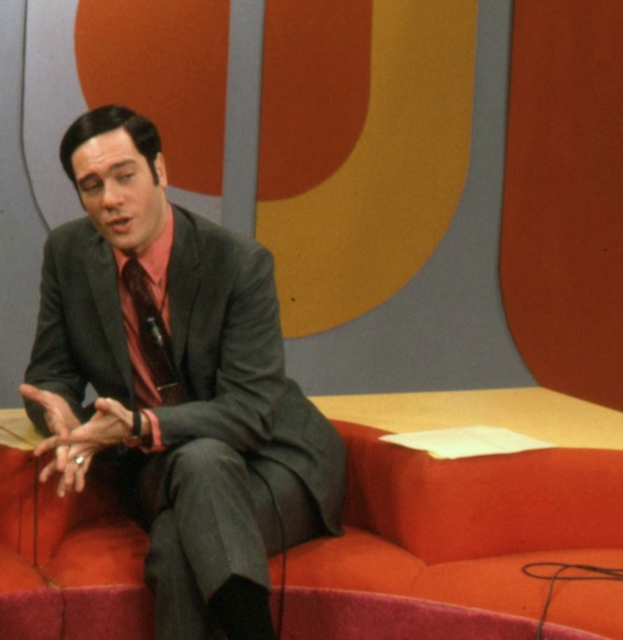
(Arnold Zenker – The Arnold Zenker Show – WJZ -TV 1970)
CBS recently cancelled the airing of a 60 Minutes story about the Trump Administration sending Venezuelan immigrants, without even a hint of due process, to a brutal El Salvador prison, even though the story had been well vetted by experienced, highly respected CBS journalists and lawyers. Blocking the anti-Trump story has the markings of a pretty clear effort by billionaire Larry Ellison, whose son controls Paramount and CBS, to curry Trump’s favor in his bid for Warner Brothers.
It brings to mind an earlier era, when abuse of power was also a concern: the “Tricky Dick” Nixon era.
In 1970 I worked at WJZ-TV in Baltimore, which was owned by Westinghouse Broadcasting, as highly respected for it’s ethics as CBS, “The Tiffany Network” of that time.
I produced and directed “The Arnold Zenker Show”, a 9AM -to 10AM talk show. Arnold had been a lawyer for CBS until he filled in for Walter Cronkite during a strike and liked it so much he became a talk show host. He was quick-witted, smart, and a superb interviewer. As a result, the show had top ratings in Baltimore and even did well in Washington DC, although its signal only reached about half of the city, including the White House.
The primary job of a talk show production staff is to find compelling guests. How did we do that? Aside from booking publicity-seeking celebrities, we read over a dozen newspapers every day, along with numerous magazines and periodicals, looking for unique stories and people.
One morning that fall I was leafing through LIFE magazine when I saw a story about about an FBI agent, named John Shaw, whose resignation from the FBI had been accepted by J. Edgar Hoover “with prejudice”, a phrase that effectively barred him from any future law enforcement job. LIFE had tried for an interview but lost track of him in Baltimore.
I had lots of contacts in Baltimore and DC, so I made a few phone calls and waited. Around 2:00 pm, the phone rang and a voice said “I hear you’re looking for me.” I booked him for the next morning.
He arrived early in a dark suit, dark tie, and white shirt, the FBI uniform of the time. He was polite and soft spoken.
Arnold skillfully brought out a story was as sad as it was shocking. In a personal letter to the professor of a graduate course he was taking, Shaw had criticized the FBI, not for the quality of its work, but for the outmoded quality of it’s procedures and policies. Hoover, the highly revered (at the time) Director of the FBI, saw the letter, slammed Shaw for “atrocious judgment”, suspended him for 30 days, and ordered him transferred from Washington DC to Butte, Montana. Because his wife was extremely ill (she died later that year), Shaw resigned rather than move. Hoover responded with a telegram accepting the resignation “with prejudice”. At the time he appeared on our show, he was still out of work.
An hour or two after the show I got a message from the White House asking for a copy of the show. They didn’t say why.
A call from the White House, which our show had poked more than once, was concerning.
Even though it was a “live” show, it was aired on a “tape delay” of a few seconds, allowing us to bleep, for example, the “F” word. In other words, I couldn’t claim we didn’t have a tape.
At that time Westinghouse had an “Area VP” in Baltimore who dealt primarily with Washington bigwigs. I went up to his office, sat down and said “I think I might have screwed up.”
“What do you mean? By the way, good show today.”
“The White House called. They want a tape of the show.”
He immediately understood. He leaned back, thought for a minute, and said. “Call them back. Tell them we’d be glad to make a copy – it’ll cost $5000. And a machine to play it will cost $100,000.”
(In the early 70’s television stations used Ampex or RCA Video Tape Recorders, the size of large bookcases, to record video and sound onto reels of 2 inch wide tape. They cost $100,000 and more).
I went back to my office, called the White House and left the message. They never called back.
A few months later, with assistance from the ACLU, Shaw sued the FBI for a “capricious and vindictive act of personal retribution” by Mr. Hoover, and won. The FBI removed the phrase “with prejudice” from Shaw’s records and paid him $13,000, the amount of salary he’d lost. He got a job with the Insurance Crime Prevention Institute, an organization begun by a former New Haven Police Chief, James F. Ahern.
Three years later, Nixon resigned under the threat of being impeached for the raid on the Democratic National Committee Headquarters in the Watergate complex.
In those days the media – and people – stood up to power. Today they stand up for oligarchs.
I never thought I’d see a day when “Tricky Dick” would look noble. But here we are.